Philips introduces SmartIQ to address the trade-off between image quality and radiation dose in coro
May 18, 2026
- Greater differentiation of clinical details through contrast-rich images with reduced background noise
- For coronary procedures, a new ultra-low dose protocol employs over 50% less X-ray radiation dose [1]
- First SmartIQ clinical pilot study published in JSCAI, further building on Philips’ strong track record in evidence generation [2]
Amsterdam, the Netherlands – Royal Philips (NYSE: PHG, AEX: PHIA), a global leader in health technology, today announced Philips SmartIQ, a breakthrough coronary imaging technology for its Azurion image-guided therapy. Developed in collaboration with leading cardiovascular centers, SmartIQ is designed to address one of the field’s most fundamental challenges: the trade-off between image quality and radiation exposure for patients and clinical staff. It aims to empower clinicians with exceptional image quality, enabling them to see exactly what they need, while it aims to provide reassurance that X-ray dose and contrast levels are optimized.
“With this new imaging technology, we can go really low in dose and achieve even better image quality. It’s a win-win,” said Dr. Mark Winkens, Interventional Cardiologist at Elisabeth-TweeSteden Hospital (ETZ) in Tilburg, the Netherlands.
Philips will showcase SmartIQ at EuroPCR 2026 (May 19–22, Paris, France), where attendees can experience the technology firsthand and hear directly from early clinical adopters. During dedicated clinical sessions, clinicians will share initial case experiences and present real-world multicenter results. Leveraging Philips’ strong track record in evidence generation, the first blinded clinical pilot study evaluating SmartIQ was recently published in Journal of the Society for Cardiovascular Angiography & Interventions. The study suggests that the algorithm scored higher on image quality and was preferred in the vast majority of blinded comparisons, while maintaining or lowering radiation and contrast dose.
Philips Azurion with SmartIQ technology
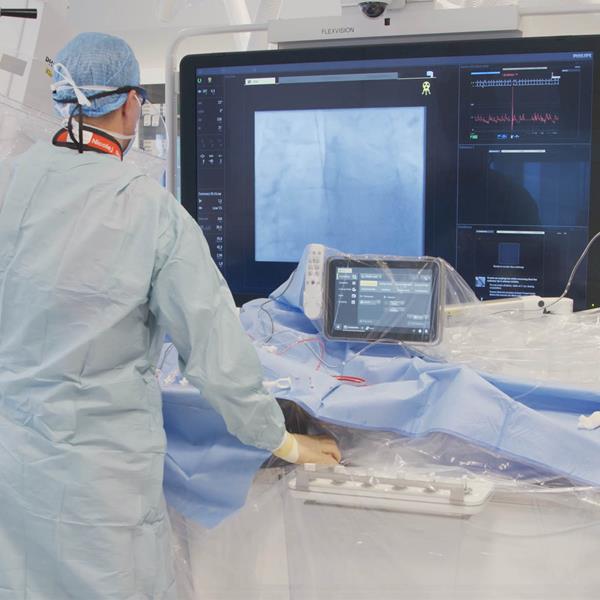
Physicians are using Philips Azurion with SmartIQ technology during an medical procedure.
The technology builds on Philips’ industry-leading ClarityIQ platform, which has previously been associated with radiation exposure reductions between 23% and 83%, depending on the clinical area [3]. In parallel, further strengthening Philips’ evidence-generation efforts, the ongoing RADIQAL trial is designed to assess the impact of SmartIQ on radiation dose compared to ClarityIQ while maintaining procedural performance. The study has recently reached 60% of total enrollment and completed enrollment at European sites, marking an important milestone. Final study completion and results are expected in due course.
SmartIQ represents the next step forward in image quality and dose management for coronary imaging. It includes an ultra-low dose protocol for coronary procedures that employs over 50% less X-ray radiation dose compared with the lowest dose settings available with Philips ClarityIQ [1]. This setting aims to enable acquisition of coronary cine runs at fluoroscopy dose levels, depending on system and clinical conditions [4].
“For too long, clinicians have had to choose between image quality and radiation dose during coronary procedures,” said Mark Stoffels, Business Leader Image-Guided Therapy Systems at Philips. “With our breakthrough SmartIQ technology, we believe that trade-off no longer has to define coronary imaging. This is not an incremental step forward – it represents one of Philips’ boldest advances yet in helping clinicians see what they need while aiming to further reduce exposure for patients and clinical teams.”
“Image quality is the foundation of every decision we make in the cath lab. SmartIQ has genuinely surprised us. It delivers the clarity we need at very low radiation dose levels,” said Dr. Nicolaj Brejnholt Støttrup, Interventional Cardiologist at Aarhus University Hospital in Aarhus, Denmark.
SmartIQ is the latest example of Philips’ long-term commitment to reducing radiation exposure across image-guided therapy. Together with innovations such as DoseAware, LumiGuide and EchoNavigator, it reflects a system-wide approach designed to help clinicians achieve the image quality they need while continuing the aim to reduce radiation exposure for patients and staff.
SmartIQ is CE-marked and available in Europe and selected markets on both new and existing Azurion systems. The technology is not yet cleared for use in the United States.
[1] Compared with the low ClarityIQ setting on Azurion systems, SmartIQ ultra-low left coronary 15 fps cine runs specify average reference air kerma reductions of 58% on Azurion M12 and 62% on Azurion M20 across all field sizes as stated in the IFU.
[2] Assar et al., Exploring a Novel Processing Algorithm to Improve Image Quality and Reduce X-Ray and Contrast Dose for Coronary Angiography: A Blinded Pilot Study. Journal of the Society for Cardiovascular Angiography & Interventions, 2026, 105343
[3] In 37 individual comparative studies, Philips ClarityIQ was associated with reductions in patient radiation exposure. The results of the application of dose reduction techniques will vary depending on the clinical task, patient size, anatomical location and clinical practice. The interventional radiologist assisted by a physicist as necessary has to determine the appropriate settings for each specific clinical task. See website: https://www.philips.com/clinicallyproven
[4] The radiation dose reduction potential of SmartIQ is currently investigated in the RADIQAL trial. The RADIQAL trial is a multi-center randomized clinical trial to assess the impact of SmartIQ on radiation dose compared to the current ClarityIQ while maintaining procedural performance. This includes a comparison to the limitation of the reference air kerma rate in fluoroscopy of <88 mGy/min as stated in FDA 21CFR1020.32 and international standard IEC 60601-2-54. For details about RADIQAL, visit https://clinicaltrials.gov/study/NCT06944509.
About Royal Philips
Royal Philips (NYSE: PHG, AEX: PHIA) is a leading health technology company focused on improving people’s health and well-being through meaningful innovation. Philips’ patient- and people-centric innovation leverages advanced technology and deep clinical and consumer insights to deliver personal health solutions for consumers and professional health solutions for healthcare providers and their patients in the hospital and the home.
Headquartered in the Netherlands, the company is a leader in diagnostic imaging, ultrasound, image-guided therapy, monitoring and enterprise informatics, as well as in personal health. Philips generated 2025 sales of EUR 18 billion and employs approximately 64,800 employees with sales and services in more than 100 countries. News about Philips can be found at www.philips.com/newscenter.
Attachment

- 国云注智,天翼云携手业界共绘西藏数智新蓝图
- 2024DMS冠军经典赛(百色站) 暨第二届红城百色健美健身公开赛圆满落幕
- 亚太区企业将在2024年增加公共云存储支出和容量,同时迎接人工智能/机器学习普及带来的机遇
- 从单点突破到生态协同!第九届深商盛典奏响中国品牌出海三重奏
- 年货进京1号线 有“蛇”有得新年见——热烈庆祝宁武县乐村淘电子商务服务有限公司入选北京地铁1号线年货进京专列
- 2025临沂“沂”起行动低空经济高峰论坛新闻发布会举行
- Kioxia Holdings Corporation荣获2024年DealWatch Awards年度股票类IPO大奖
- Canoga Perkins和Druid为关键任务专用5G网络提供支持FRER的高韧性解决方案
- 全球第一!IDC:萤石稳居 2025 年消费类摄像头出货量全球榜首
- 硅基仿生携手中国出生缺陷干预救助基金会:以科技温情,守护“糖宝”健康未来
- 必胜客牵手《新世纪福音战士》,持续深耕品牌年轻化
- 空净十大品牌IAM引领高端市场,蝉联两年全网销量第一
- 人人想买! 招商揽阅价格已公示+纯新盘售楼部即将开放!
- 姚安娜新剧饰演急诊医生演技自然,网友感叹之前还是对她太大声了!
- 海能达亮相第六届金砖国家未来网络创新论坛
- Cathexis以58亿美元出售Yondr
- 破解高密散热难题, 维谛技术(Vertiv) 360AI混合制冷方案重塑AI时代热管理
- 定义新时代:锦波生物以“人源化胶原蛋白”重塑产业认知与生态
- 爱尔眼科李绍伟教授团队一项真菌性角膜炎管理多中心研究成果发布
- dynabook智能工厂助力中国企业数字化转型
- 中医文化传承的味觉载体与创新密码:药食同源
- Sunstice 入选 2026 年 Gartner® 供应链计划解决方案(流程行业)魔力象限™
- Canva Launches Creative Operating System
- 中国文化 世界共享——书法名家叶新仁
- Global Tech and Durables Market in Recovery Mode
- KnowBe4利用先进AI坐席来提高效果和速度
- 云三七酒高调亮相2025成都糖酒会 以AI工艺进入健康白酒赛道
- 双奖加冕!益芽口腔陈奇院长荣膺隐适美隐形矫正亚太区Top Provider称号!
- WillScot Mobile Mini to Announce First Quarter 2024 Results on May 2, 2024
- 瑞士SIAC即将进驻亚洲地区医药保健领域