WeRide Introduces WITT, a Physical AI Cognitive Foundation Model Built on Atomic Physical Facts

New model transforms real-world operational data into trusted facts and trusted facts into learning signals for Physical AI systems
Key Highlights
- WeRide unveils WITT (World Intelligence Toward Truth), a Physical AI Cognitive Foundation Model designed to build AI cognition of the physical world through trusted facts extracted from real-world experience.
- WITT introduces Atomic Physical Facts (APFs), the smallest verifiable units of information about the physical world, establishing a new fact-based cognitive framework for Physical AI.
- Built on four core capabilities—Fact Extraction, Fact Reasoning, Fact Verification and Fact Curation—WITT continuously transforms real-world data into trusted learning signals for AI training, evaluation and iteration.
- Compared with significantly larger general-purpose AI models, WITT reduces token costs by up to 98% and delivers up to 200x greater data-processing efficiency.
SHANGHAI, July 17, 2026 (GLOBE NEWSWIRE) -- WeRide (NASDAQ: WRD, HKEX: 0800), a global leader in autonomous driving technology, today unveiled WITT (World Intelligence Toward Truth), a Physical AI Cognitive Foundation Model designed to build AI cognition of the physical world through trusted facts extracted from real-world experience.
Leveraging visual-language model (VLM) capabilities, WITT introduces a new concept called Atomic Physical Facts (APFs) and establishes a fact-based cognitive framework for Physical AI. By connecting multimodal information across video, images and text, WITT decomposes continuously evolving real-world environments into verifiable facts that can be identified, reasoned about and validated, establishing a new generation of AI understanding centered on physical facts.
WITT stands for World Intelligence Toward Truth and is inspired by the philosopher Ludwig Wittgenstein, whose proposition that “the world is the totality of facts” closely aligns with the underlying logic of Physical AI. To build cognition of the physical world, AI must first identify trusted facts embedded in environments, behaviors, rules, risks and temporal relationships. These facts become the foundation for reasoning, judgment and decision-making.
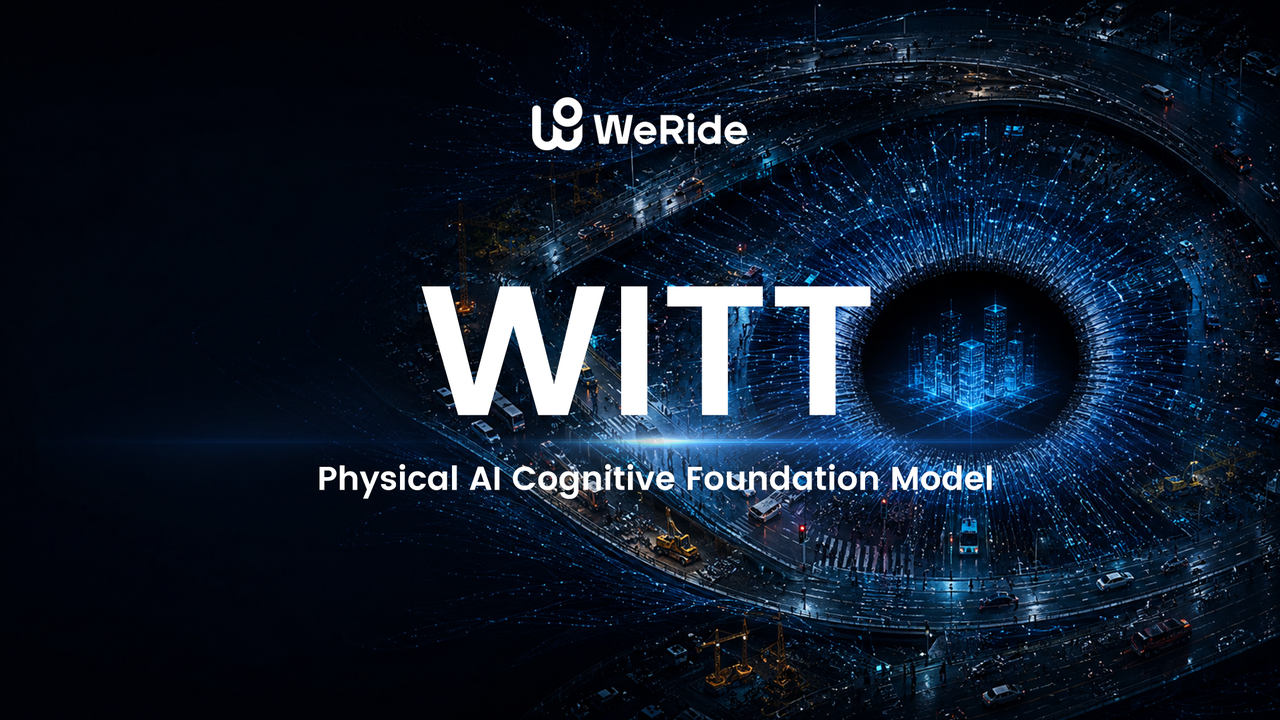
WeRide WITT, a Physical AI Cognitive Foundation Model built on Atomic Physical Facts
As Physical AI moves from research into real-world deployment, autonomous driving has emerged as the first domain to achieve large-scale commercial validation. Yet building AI systems that can reliably understand the physical world remains a fundamental challenge.
Vast amounts of real-world data continue to grow exponentially, identifying and utilizing data with genuine training, evaluation and iteration value remains difficult. High-value long-tail scenarios are inherently scarce, while datasets collected from both L4 autonomous driving operations and production ADAS systems often contain human interventions, inactive segments and other forms of noise. General-purpose AI models can also struggle to interpret complex traffic environments consistently, leading to hallucinations, factual errors and incomplete scene understanding.
The industry increasingly needs an efficient and trusted mechanism for understanding data— one capable of continuously extracting meaningful scene facts from real-world driving data, improving the quality and efficiency of training, evaluation and model iteration, and transforming real-world experience into trusted learning signals that drive the evolution of autonomous systems.
WITT was developed to address this challenge.
Rooted in WeRide’s large-scale autonomous driving operations, WITT continuously extracts patterns, relationships and trusted facts from vast volumes of operational data. Rather than treating data as raw inputs for model training, WITT treats trusted facts as the fundamental building blocks of Physical AI cognition. This foundation enables the model to transform real-world experience into structured knowledge through four core capabilities: Fact Extraction, Fact Reasoning, Fact Verification and Fact Curation.
Together, these capabilities create a complete pipeline spanning scene understanding, event attribution, data validation and learning curation—allowing every kilometer of real-world driving data to become a trusted signal for model improvement.
Fact Extraction
WITT identifies and extracts three categories of Atomic Physical Facts from real-world driving data: standard driving facts, multi-agent interaction facts and physically ambiguous conditions. Together, these facts capture everyday traffic behaviors, evolving relationships among traffic participants and uncertainty within complex physical environments.
For example, a driving video can be decomposed into multiple Atomic Physical Facts, including reduced visibility caused by rain, a pedestrian entering a crosswalk, an ego vehicle slowing down, a nearby vehicle traveling in parallel, changing traffic signals and increasing collision risk. Each fact is designed to be highly reliable, traceable and verifiable, enabling richer scene descriptions and providing the foundation for subsequent reasoning, validation and learning.
Fact Reasoning
After extracting facts, WITT analyzes key events, behavioral relationships and evolving risks within a scene, while identifying the underlying causes and potential trajectories of those events.
During the R&D phrase of Autonomous Driving, engineers often need to search vast video datasets for specific long-tail scenarios, such as pedestrians suddenly crossing in construction zones, lane departures under poor visibility conditions, or complex yielding maneuvers in narrow-road encounters. Powered by an integrated video intelligence engine, WITT enables users to retrieve target scenarios through keywords or natural-language queries, dramatically improving the efficiency of scenario discovery, data investigation and root-cause analysis.
Fact Verification
To reduce hallucinations commonly associated with general-purpose AI models, WITT evaluates outputs across six dimensions:
- Vulnerable road users
- Ego-vehicle behavior
- Surrounding vehicle behavior
- Scene understanding
- Comprehensive fact
- Traffic facilities
The model introduces factual confidence scoring and validates conclusions against external physical evidence to determine whether interpretations are supported by observable reality.
By tracking factual errors, hallucinations, omissions and temporal inconsistencies, WITT provides both a quality benchmark for data users and a preference signal for model training, continuously guiding AI systems toward more accurate and physically grounded understanding.
Today, WITT achieves an average factual error rate approximately one-third that of leading general-purpose AI models in autonomous driving scenario understanding tasks.
Fact Curation
In real-world operations, not all data contribute equally to model learning. WITT automatically identifies high-value facts and routes them into the most effective learning workflows to maximize model improvement.
Rare long-tail scenarios can be returned to WeRide GENESIS, the company’s proprietary general-purpose simulation model, for simulation training and scenario expansion. High-frequency everyday scenarios can support reinforcement learning and workflow optimization. Abnormal or ambiguous data can be directed into review processes to prevent valuable information from being mistakenly discarded as noise.
By ensuring that every piece of data follows the most appropriate learning path, WITT maximizes the value of real-world operational data and continuously converts experience into model intelligence.
Within WeRide’s Physical AI architecture, WITT serves as the critical understanding and evaluation layer. Together with WeRide GENESIS, the company’s proprietary general-purpose simulation model, WITT forms a Physical AI flywheel that continuously converts real-world experience into model improvement.
WITT extracts, understands, verifies and curates physical facts from real-world data, while GENESIS generates high-fidelity simulation environments and long-tail training scenarios based on those facts. Together, the two systems train and improve vehicle-side models, enabling autonomous driving systems to continuously evolve through both real-world experience and synthetic-world learning.
Compared with general-purpose AI models that often rely on hundreds of billions of parameters, WITT delivers strong performance with a significantly more efficient architecture. The model reduces token costs by up to 98%, processes up to 10,000 minutes of vehicle-operation video per day on a single GPU and delivers up to 200 times greater data-processing efficiency in comparable workloads.
In labeling workflows, a single request to WITT can generate more than 100 dynamic tags, enabling massive volumes of real-world driving video to be rapidly retrieved, validated and incorporated into model-development pipelines, where they become continuously accumulating fact assets.
Supported by this Physical AI flywheel, WeRide has become the world’s only company to achieve large-scale commercial deployment of both L4 autonomous driving and L2++ intelligent driving systems.
In the L4 domain, WeRide has obtained autonomous driving permits across eight countries and markets, deployed autonomous driving products in more than 40 cities across 12 countries, and operates a fleet of more than 3,000 autonomous vehicles. Its Robotaxi services have already achieved regular, large-scale fully driverless commercial operations in Guangzhou, Beijing, Abu Dhabi and Dubai.
At the same time, high-quality data and model capabilities accumulated through L4 operations are continuously being transferred to WeRide’s one-stage end-to-end ADAS solution through the company’s Physical AI flywheel. Today, WRD 3.0 has secured an unprecedented six consecutive wins at the China Urban Intelligent Driving Competition. The solution has also been selected for close to 30 vehicle programs and entered production on multiple vehicle platforms, including models from Chery Exeed and GAC Aion. Beyond China, it has expanded technology validation footprint into international markets such as Germany, France and Japan.
Starting from autonomous driving—one of the most data-intensive and operationally complex environments for Physical AI—WITT demonstrates a broader potential for Physical AI applications.
As Physical AI enters a new phase of large-scale deployment, WeRide will continue advancing cognitive foundation models grounded in real-world validation, enabling AI to move beyond understanding the physical world toward operating within it at scale.
About WeRide
WeRide is a global leader and a first mover in the autonomous driving industry, as well as the first publicly traded Robotaxi company. Our autonomous vehicles have been tested or operated in over 40 cities across 12 countries. We are also the first and only technology company whose products have received autonomous driving permits in eight markets: China, the UAE, Singapore, France, Switzerland, Saudi Arabia, Belgium, and the US. Empowered by the smart, versatile, cost-effective, and highly adaptable WeRide One platform, WeRide provides autonomous driving products and services from L2 to L4, addressing transportation needs in the mobility, logistics, and sanitation industries. WeRide was named to Fortune's 2025 Change the World and 2025 Future 50 lists.
Media Contacts
WeRide: pr@weride.ai
Safe Harbor Statement
This press release contains statements that may constitute “forward-looking” statements pursuant to the “safe harbor” provisions of the U.S. Private Securities Litigation Reform Act of 1995. These forward-looking statements can be identified by terminology such as “will,” “expects,” “anticipates,” “aims,” “future,” “intends,” “plans,” “believes,” “estimates,” “likely to,” and similar statements. Statements that are not historical facts, including statements about WeRide’s beliefs, plans, and expectations, are forward-looking statements. Forward-looking statements involve inherent risks and uncertainties. Further information regarding these and other risks is included in WeRide’s filings with the U.S. Securities and Exchange Commission and announcements on the website of the Hong Kong Stock Exchange. All information provided in this press release is as of the date of this press release. WeRide does not undertake any obligation to update any forward-looking statement, except as required under applicable law.
A photo accompanying this announcement is available at https://www.globenewswire.com/NewsRoom/AttachmentNg/1c65b514-0de6-4659-aa53-fa043da4cdf1

- 明冠新材0BB封装方案创新与技术专利布局,助力光伏降本进程
- 首适科技携手2024世界品牌莫干山大会共绘产业蓝图
- 粉色口红和园艺高手:Mary Kay Inc.在路易斯维尔举行植树活动以纪念可持续美容60周年
- Vivek Kumar Named President and CEO of JA Asia Pacific
- 魔幻电音 “噪”浪山野!北京山谷首届电音节再掀音乐狂潮
- 《群星闪耀时》收官,年轻小花宋芳园表现可圈可点
- 金佰威上海案例丨1500m²现代别墅,自然与奢华交融
- 首个液冷整机柜服务器行业标准发布,兰洋科技核心参编!
- Bitget Spreads Kindness This Ramadan by Providing 100,000 Meals to Those in Need
- 柔佛成东南亚数据中心新枢纽,Zenlayer助中企借柔新特区高效出海
- AI+投建运新质生产力 工程管理创新大会(2026)在成都隆重召开
- 老中医黄德基;以岐黄之术承家国情怀,以医者仁心续民族精神
- 从Uniswap Fee Switch提案,看DeFi的价值回归
- 服务品质新标杆!东软医疗核心影像设备客户满意度包揽榜首
- Bitget's Liquidity Depth Analysis Highlights Competitive Edge in Crypto Trading
- Sonar to Improve the Quality of AI-Generated Code, Provide Automated Fix Recommendations
- QPS推出新的Leukopak和细胞治疗产品设施
- Medisca启用新的药品再包装设施,以满足全球对个性化医疗的需求
- 《同源康医药甲磺酸艾多替尼片(TY-9591),提交Pre-NDA申请》
- 别让水质毁了游泳体验!AQUA爱克泳池设备的全链条守护秘籍
- 纪录片《寻味东莞》上线,女性视角获得关注
- 中国文化·世界共享——书画名家戴建华作品鉴赏
- 卓越再续丨中科视语蝉联“AI+智慧交通优秀企业”称号
- 智惠彩云之南 绿筑发展新篇 ——“彩云英才荟”搭建皖滇绿色技术协同创新桥梁
- 东莞医大医院耳鼻喉科:汇聚京沪粤知名专家 专注耳鼻喉诊疗与研究
- 诚邦股份:踩准存储超级周期,打开估值向上空间
- 九章云极DataCanvas公司强势入选IDC生成式AI图谱7大核心板块
- 首批北斗共享电动自行车落地株洲,千寻位置打造城市低碳智慧出行新标杆
- Rosen Law Firm敦促损失巨大的Maxeon Solar Technologies, Ltd. (NASDAQ: MAXN)股东与律所联系以获取有关其权利的信息
- Superfoods, robots and AI: innovation bursts onto the scene at Alimentaria & Hostelco