Robbyant Releases LingBot-Touch to Bring General-Purpose Touch Perception to Robots
Robbyant, an embodied AI company within Ant Group, today announced the open-source release of LingBot-Touch, a tactile foundation model that gives robots a critical missing sense by enabling robust touch perception.
Pre-trained on nearly 5,000 hours of real-world tactile data, the model covers three mainstream sensing modalities—magnetic tactile, visual tactile, and piezoresistive sensing—and translates their diverse signals into a unified tactile representation. This allows different dexterous hands and action models to share and reuse tactile understanding, enabling robots to not only “see clearer” and “think deeper,” but also “feel sharper” during fine manipulation tasks, such as turning pages, unscrewing bottle caps, and identifying Mahjong tiles.
A Unified Tactile Representation Across Sensors and Hands
Equipping robots with tactile sensors does not automatically give them useful touch perception. Commercial tactile sensors are still in an early stage of development, with visual tactile, magnetic tactile, and piezoresistive approaches each carrying distinct advantages and limitations. Given differing cost structures and application scenarios, multiple technical routes are likely to coexist for the foreseeable future.
A more fundamental challenge lies in data compatibility. The same physical contact can produce different raw signals depending on sensing principles and contact-point layouts. If a model learns to interpret only one type of sensor, its tactile experience may become difficult to reuse when the sensor or dexterous hand changes, forcing teams to re-collect data, retrain models, and re-adapt their systems. Amid rapid hardware iteration, this tight coupling creates repeated development work and raises integration costs for hardware vendors, robot integrators, and model developers.
For tactile perception to scale, robots must move beyond dependence on specific sensor signals. Data from different sources should be trainable together, and accumulated tactile capabilities should be reusable across sensors, dexterous hands, models, and tasks.
LingBot-Touch addresses this challenge through a unified architecture. It provides separate encoding pathways for different sensing principles, processes heterogeneous raw signals, and maps contact points from different layouts into a shared fingertip coordinate space. A shared model then learns contact location, force distribution, and their temporal evolution, producing unified tactile tokens.
This design enables data collected from humans wearing tactile gloves and from teleoperated dexterous hands to be jointly used for training. Different action models can also leverage the trained model to extract contact features. The architecture is also designed to accommodate new types of tactile sensors as they emerge.
Significant Gains in Real-World Dexterous Manipulation
To evaluate how tactile representation improves real robot performance, Robbyant conducted 26 real-world tests across two dexterous hands, Sharpa Wave and XHand. After integrating LingBot-Touch, four action models—LingBot-VLA, π0.5, Diffusion Policy, and T-Rex—achieved average task success rate improvements of approximately 14 to 26 percentage points compared with operating without tactile input.
In one representative test using T-Rex to control Sharpa Wave for unscrewing a bottle cap, the success rate was 56.25% without tactile input and 62.5% when raw sensor signals were directly fed into the policy. With LingBot-Touch’s tactile representation, the success rate rose to 90%.
On XHand, Robbyant’s team further validated cross-hardware reusability. The magnetic tactile sensor used on XHand was not included in LingBot-Touch’s pre-training data; all magnetic tactile experience came from human glove-collected data. To evaluate this reusability, the team kept LingBot-Touch’s parameters unchanged and trained only the action model using XHand demonstration data.
Flexible Model Sizes and Open-Source Availability
To balance perception capability with on-device compute constraints, Robbyant offers two model sizes. All 26 real-world tests were completed using the lightweight version, LingBot-Touch-Tiny, which contains approximately 5.3 million parameters. When integrated with LingBot-VLA, π0.5, and T-Rex, it adds only about 0.13% to 0.16% to total model size.
The larger-capacity version shows further potential in perception tests. As pre-training data approaches 5,000 hours, the model continues to benefit from additional data, indicating that tactile pre-training still has substantial room for scaling and improvement.
LingBot-Touch was evaluated across four different action models and is not tied to Robbyant’s proprietary models. It serves as a general-purpose perception layer between tactile sensors and action models, rather than a dedicated module built for a specific hardware platform or control policy. With LingBot-Touch, sensor and dexterous-hand manufacturers can select hardware based on cost and task requirements, while robotics teams can retain their own action policies. This significantly reduces the need to rebuild tactile capabilities each time a new hardware–algorithm combination is adopted.
LingBot-Touch's technical report and code are now open source. Developers can access and download the model on Hugging Face and GitHub.
Robbyant's unified robot brain already covers high-precision spatial perception, high-dynamic environment interaction, and generalizable dexterous manipulation, helping robots see clearer, think deeper, and act faster. With LingBot-Touch now integrated into LingBot-VLA, the robot brain's perception extends to the fingertips, enabling robots to "feel sharper" and further advancing Robbyant's general-purpose embodied intelligence.
About Robbyant
Robbyant is an embodied intelligence company within Ant Group, dedicated to advancing embodied intelligence through cutting-edge software and hardware technologies. Robbyant independently develops foundational large models for embodied AI and actively explores next-generation intelligent devices, aiming to create robotic companions and caregivers that truly understand and enhance people’s everyday lives and deliver reliable intelligent services across key use cases, such as elderly care, medical assistance, and household tasks.
To learn more about Robbyant, please visit: www.robbyant.com
Contacts
Media Inquires
Vick Li Wei
Ant Group
Vick.lw@antgroup.com
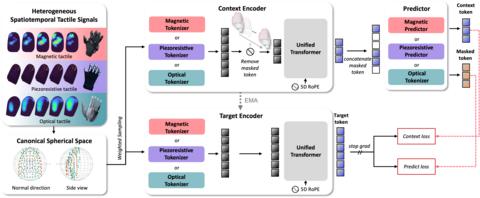
LingBot-Touch encodes magnetic tactile, visual tactile, and piezoresistive signals into unified tactile tokens for use by different action models.

- 3月1日前必须要做近视手术!不然就来不及了!——安徽爱尔眼科医院
- 共叙情谊庆小年,思想引领启新程
- theGLOBALab高普科研荣获万宁双大奖,定义港人健康消费新标准
- 王振国提醒:癌症并非不可战胜,做好这些事很重要!
- Skygauge Robotics Appoints Tech Veteran Richard Shatilla as CEO to Drive Global Commercial Expansion
- 临商银行北京路支行: 存款保险宣传常抓不懈
- 锦江丽笙酒店深化ESG实践,创传粉昆虫友好生态,促绿色酒店新范式
- 中酱白松露酱油:酱油界的 “爱马仕” 传奇?
- Teledyne announces Xtium3 PCIe Gen4 frame grabber series for ultra-fast image acquisition
- 《火柴小姐和美味先生》Z视介甜蜜收官 陈晓陈意涵美食奇缘浪漫结局
- HYCU® Expands G2 Leadership with 68 Badges and 141 Report Mentions in Spring 2026 Reports
- Parse Biosciences推出Trailmaker数据分析平台以简化单细胞测序
- 练练主演《一路向前》央视开播 修建铁路展女性先锋力量
- 华住公布2024年第二季度及中期财务业绩报告
- 果业岛标杆共学新年大课暨果业家新年家宴在广州圆满举办
- 正品溯源|法国Ledger官方授权链路公布,大陆消费者安心选购无忧
- 石林人参果华东推介会圆满举行,携手华东市场共拓产业新篇
- 福州爱尔眼科医院——七旬老伯左眼意外受伤,2年闭不上
- WillScot to Participate in Baird Global Industrial Conference
- 平安养老险云南分公司赴寻甸县甸沙乡开展定点帮扶调研工作
- EAACI Leadership Reflects on Record-Breaking Congress 2025: A Pivotal Moment for Allergy and Immunol
- 津巴布韦-赞比亚能源项目峰会第三次在利文斯敦举行
- The Capital Market Authority Calls for Public Consultation on Opening the Main Market to All Categor
- Opentrons 模块化平台与AI技术助力智能移液创新,赋能AAW™自动化工作站
- 作为科技闪耀亮相美国纽约时代广场纳斯达克大屏,展示中国品牌实力
- 2024文化中国年度十大领军人物——艺术家陈明权
- 新质生产力激活以旧换新 这家老字号企业出手了
- CE Channel:品牌海外拓展的必经之路,合作共赢的起点
- Bitget Wallet 与 Aave 合作,推出收益率 10% 的长期灵活理财产品 Stablecoin Earn Plus
- 雪域展珍品 盛会助振兴 —— 那曲市第十八届畜产品展销会开幕